
Bauhaus Weimar 1919–1925
With greetings from Weimar!
1) Bauhaus - How it Was Founded
The Bauhaus is a product of the Weimar Republic. It was founded by Walter Gropius in Weimar in 1919.
Gropius set out to reform the training of artists. He integrated Henry van de Velde’s School of Arts
and Crafts, which had been closed since 1915, and the Grand Ducal Saxon College of Fine Arts into
one school: the State Bauhaus in Weimar.
2) Walter Gropius
Gropius was trained as an architect. He was director of the Bauhaus in Weimar from 1919 to 1925
and in Dessau until 1928. In a period of upheaval, he established a brand new way of teaching and a
new university.
3) Craftsmanship Over Art
In his Bauhaus Manifesto, Walter Gropius demanded a radical change in artistic education and
presented a visionary teaching programme. The Bauhaus programme asserted that art could not be
taught, but that art and craft shared the same basic concepts. Art should once again serve social
functions and there should be no more separation between fine art and craft.
Instead of studying to paint and draw like in academies, all students would instead learn a craft and
be known as apprentices and journeymen. The artists led the workshops as Masters of Form together
with the Master Craftsmen and also taught their theories of form and colour. This approach allowed
students to engage with different perspectives.
4) People at the Centre
The first Bauhaus logo, the so-called Sternenmännchen [star-man] was created by Karl Peter Röhl in a
school competition in 1919 and was replaced in 1922 by Oskar Schlemmer’s logo, which was used to
label Bauhaus products as well as for all of the school’s important printed matters.
5) Bauhaus Liked to Party!
The greater the hardship, the more important it is to celebrate, recalled Bauhaus member Andor
Weininger. In the Bauhaus Manifesto of 1919, Walter Gropius also mentioned the importance of
having music, lectures and costume parties alongside teaching. The legendary Bauhaus festivals, such
as the annual dragon festival or the lantern festival, became an integral part of school life and
contributed to the creation of myths and legends. These festivals would hold a special place in many
memories.
An indispensable part of the festive programme was the improvised performances by the Bauhaus
chapel Band. The Bauhaus drew on external ideas while opening up to the city. The Bauhaus evenings
featured a legendary performance by the expressionist poet Else Lasker-Schüler.
6) Johannes Itten
Itten was a follower of Mazdaznan teachings, which combined spirituality with physical culture and a
strict diet. Mazdaznan (a health movement that originated in the USA) also included a racial doctrine
that proclaimed the supremacy of the so-called Aryan race. In 1919, Itten launched the preliminary
course at the Bauhaus, where he introduced his art theory.
The methods focused on the perception of contrasts, colours, shapes and materials with all the
senses. He had students recreate the works of old masters and analyse their rhythm and
composition. No student could escape Itten’s influence: His courses were compulsory, and all the
workshops were run by him until 1922. Itten saw craftsmanship as a means of self-development
rather than professional training. This put him at odds with Gropius, which resulted in him leaving the
Bauhaus in 1923.
7) Wassily Kandinsky
1921 marked the beginning of disagreement over the direction of the Bauhaus. Design theory was to
be more strongly informed by scientific methods. Kandinsky conducted rigorous studies of colour and
form. He joined the Bauhaus in the summer of 1922 as a Master of Form. Kandinsky started with
concrete objects and used analytical drawings to create abstract representations. He investigated the
nature and effect of colour. He and considered colour to be subordinate to form, as colour would not
exist without form. The artist used a questionnaire to determine how basic colours and forms were
related. The findings became law for Kandinsky and his students: the circle was blue, the triangle
yellow and the square red.
8) Gertrud Grunow
‘If you think of yellow, it will make tea; if you think of brown, it will make coffee.’ These are the words
in the special instructions for a pot that Gertrud Grunow received as a gift from her students.
Grunow was a music teacher. She taught harmonisation theory at the Bauhaus from 1919 to 1924.
However, she did not teach facts or theories; instead, she opened up a new world of experience for
the Bauhaus students.
In individual lessons, she developed a personal circle of colours with them. She asked students which
sounds, movements, and materials matched the colours. This approach encouraged them to explore
and learn more about themselves through their sensations and bodies.
9) Masters’ Portfolio of the State Bauhaus, Edition 29/100
Order of prints
- Lionel Feininger: Gelmeroda, 1920, woodcut
- Wassily Kandinsky: Joyous Ascent (Fröhlicher Aufstieg), 1923, coloured lithograph
- Paul Klee: The One in Love (Der Verliebte), 1923, coloured lithograph
- Gerhard Marcus: By the Stove (Am Öfchen), 1923, woodcut
- Georg Muche: etching - not on display
- Ladislaus Moholy-Nagy: Composition (Komposition), 1923, coloured lithograph
- Oscar Schlemmer: Abstract Figure, Facing Left: Figure S (Abstrakte Figur nach links, Figur "S"), 1923,
etching - Lothar Schreyer: Grid of Beams with Diagonals (Balkennetz mit Diagonalen), 1923, woodcut
10) Marcel Breuer
The new furniture of the 1920s was light and flexible. It was not designed to take up space: People
dreamed of sitting on a column of air. Marcel Breuer used plain wood to keep the chairs affordable.
Breuer’s slatted chair was made from goods sold by the metre with the same cross-section, resulting
in hardly any waste.
11) Paul Klee
Paul Klee started teaching at the Bauhaus in 1920. He initially led the bookbinding workshop with
Otto Dorfner before taking over the glass painting workshop in 1922. In his theory of form, Klee
investigated the creation of pictorial elements. How does a dot become a line through movement? If
the dot moves, it turns into a wavy line; if it rushes towards a goal, it is on a course and turns into a
straight line. Klee also explored colour. He taught students how to create balance and structure in a
picture. Klee’s lessons were particularly influential for the students in the weaving course.
12) Benita Koch-Otte
After working as a drawing and physical education teacher, Otte left her teaching job to become a
student and then an employee in the weaving workshop. Benita Otte and Gunta Stölzl were among
the most gifted female students of the weaving workshop at the Bauhaus. Her work was greatly
influenced by Paul Klee’s teachings on form and colour, which she incorporated conceptually into her
various textiles.
13) Oskar Schlemmer
Oskar Schlemmer became one of the most prominent Bauhaus masters and temporarily led several
workshops, such as the mural painting and wood and stone sculpture workshops, before finally
becoming head of the stage workshop in 1923. The central theme of his work was always the
individual ‘as the centre of the world’ and in space. Schlemmer wanted to create human types and
not portraits of individuals. His figures were an abstraction derived from laws and outlines, becoming
two-dimensional. In 1923, Schlemmer produced several large murals for the Bauhaus exhibition in
the Bauhaus buildings. They were destroyed by the Nazis in 1930.
14) Gerhard Marcks
In October 1919, Gerhard Marcks began working as a Master of Form at the Bauhaus. The sculptor
was put in charge of a workshop for architectural ceramics. In 1920, he relocated to Dornburg, 30
kilometres away, where he and his apprentice potters lived together in a rural commune. To learn the
craft, they made clay pots and other household ceramics on the potter’s wheel, which were sold at
farmers’ markets. They were allowed to experiment with form only when they had mastered the
technique. From 1922 onwards, the potters began experimenting with automated series production
and developed prototypes that could be manufactured in factories.
15) 1923 Bauhaus Exhibition
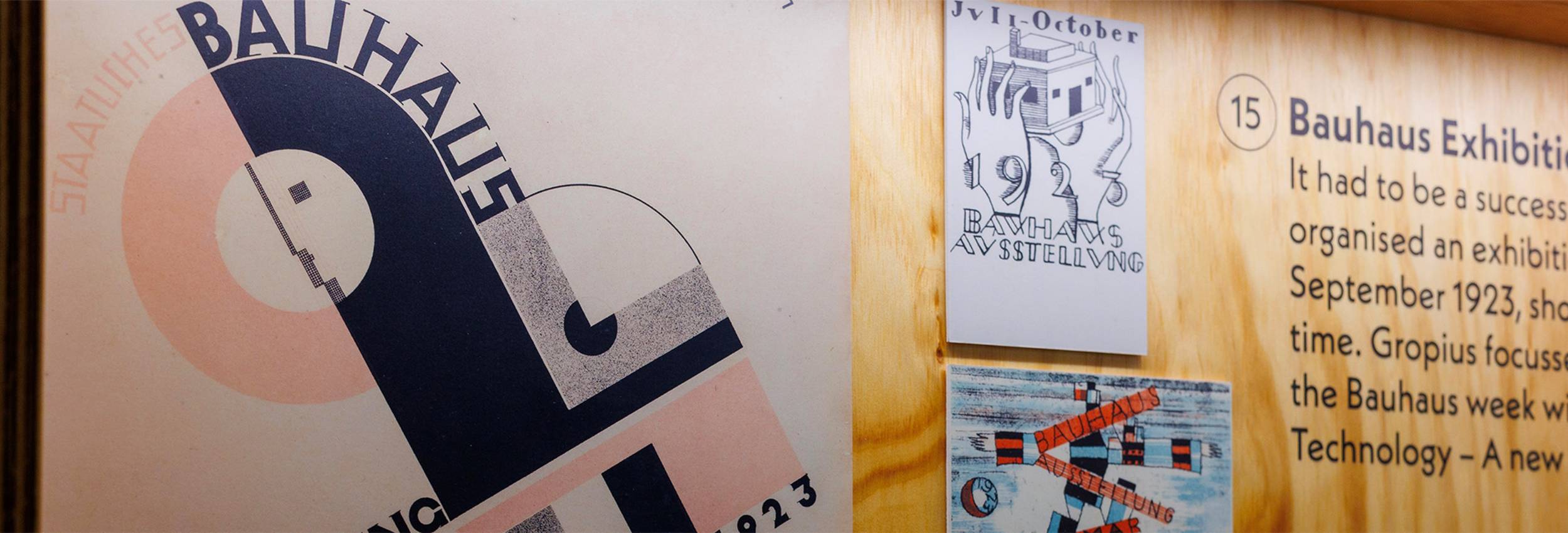
It had to be a success: At the peak of inflation, the Bauhaus organised an exhibition in Weimar from
15 August to 30 September 1923, showcasing works to the public for the first time.
Gropius focussed everything on this goal. He launched the Bauhaus week with the keynote speech
‘Art and Technology – A new Unity’. The largest exhibit was the ‘Haus Am Horn’ model house. Art
exhibitions were held in the State Museum. Works from the preliminary course and the workshops
were shown in the Bauhaus building.
The stage workshop created a programme for the Jena City Theatre. The ‘Triadic Ballet’ was
performed at the German National Theatre in Weimar, along with a music programme. Although a
financial disaster, the exhibition attracted great national and international attention, making the
Bauhaus famous.
16) Haus Am Horn
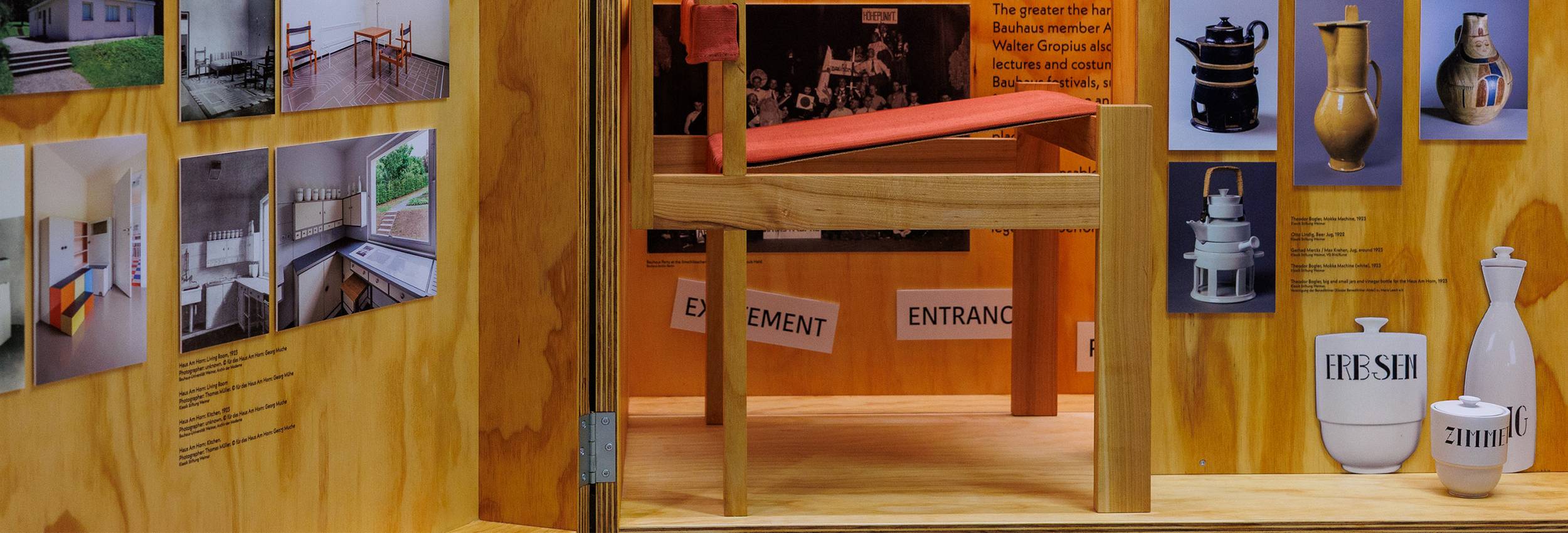
All the workshops worked together to develop a the model house for the 1923 exhibition.
Georg Muche, the youngest Bauhaus master and painter, provided the design: an affordable and
modern home for a family of three. Everything was designed around the central living space, framed
by the private rooms, bathroom, dining room and kitchen. A garden would provide food for the
family. The compact shape, the flat roof and the silver-grey façade made the house a striking feature
of the ‘Am Horn’ housing estate.
The first example of Bauhaus architecture has become a place of pilgrimage for generations of
architects. Following its restoration and the removal of extensions, the Haus Am Horn is once again
open to visitors in Weimar.
The Bauhaus in Weimar 1919–1925
The World’s Smallest Bauhaus Exhibition Goes on Tour Through Weimar’s Twin Cities
- Organised by:
- City of Weimar
- Curated by:
- Dr. Cornelia Erdmann
- Partnership & specialist advise:
- Klassik Stiftung Weimar, Bauhaus Museum Weimar
(Directorate Museeums Dr. Annette Ludwig, Dr. Ulrike Bestgen, Dr. Ute Ackermann) - Sponsored by:
- Bauhaus.Weimar.Moderne. Die Kunstfreunde e.V.
Image credits
We have made every effort to identify all copyright holders. We kindly ask persons and institutions who could not be reached and wish to claim the rights to the images used to contact us.